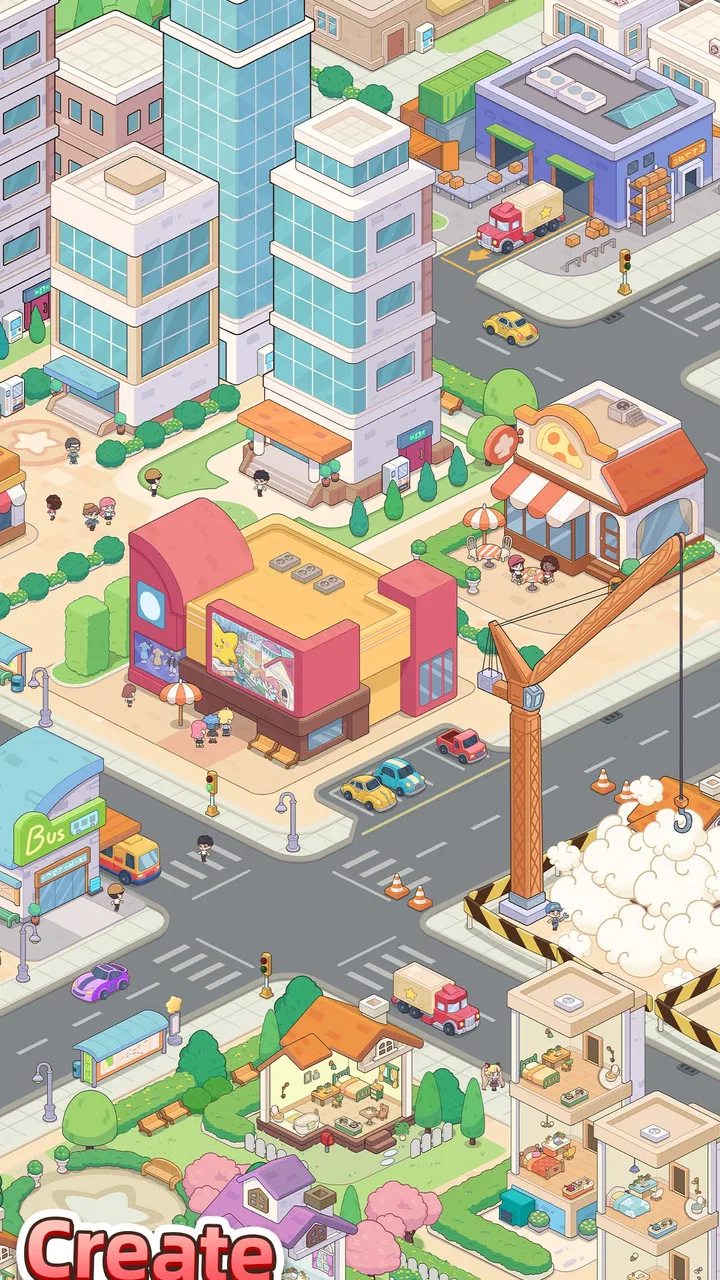
Happy Citizens - Mayor Sim
- 4.7
- Rating
- 5.00M
- Installs
- Free
- Price

 Analysis by App-foxy
Building a city sounds simple until every small decision starts affecting the people living in it. That is the appeal of Happy Citizens - Mayor Sim: it turns the familiar city-building idea into a personal story about keeping a community moving in the right direction. I found it most enjoyable when I stopped treating it like a race and began looking at each choice as part of a longer plan.
This is a free simulation game from LifeSim, aimed at Everyone, with a 4.7 average from around 104 thousand ratings and over 1 million installs. Those numbers suggest that it has found a broad audience, but they do not tell you whether its pace suits you. In my experience, it is best for players who like gradual progress, light management, and the satisfaction of improving a place one decision at a time.
What to expect when you become mayor
The central fantasy is clear: you are responsible for a growing city and the citizens who call it home. The game’s store summary, “Build Your City, Live Your Story!”, captures the basic direction, while its short description, “Happy Citizens,” points toward the real priority. Expansion matters, but it is not the only measure of success. A larger city is not especially satisfying if it feels poorly managed or if your decisions do not seem connected to the residents’ quality of life.
You May Also Like

 Google Keep - Notes and lists
Google Keep’s Quiet Growth Shows the Appeal of Simpler Notes
As mobile work gets busier, Google Keep keeps winning a simple contest: capture a thought quickly, find it later, and get on with the day.

 Blood Strike: 2.5 Anniversary
Blood Strike’s Loadouts Turn Every Drop Into a Tactical Gamble
A close look at Blood Strike’s custom loadouts: how fast access to signature weapons reshapes its battle royale rhythm, rewards preparation, and narrows the gap between fights.

 Pandora - Music & Podcasts
Pandora’s Music Is Easy to Start, but Harder to Recover
Pandora’s strength is its low-effort path from a seed to a station. Its weak spot is how much confidence it asks you to place in connection, setup, and quiet recovery.

 8 Ball Pool
 Is Built on Rivalries, Rematches, and Routine
A close look at the rivalries, rematches, shared routines, and unanswered safety questions that turn a quick pool match into a persistent mobile community.

 Samsung Music
’s Quiet Strength Is Playing What You Already Own
Its reach comes less from spectacle than from dependable access to a personal library. That simplicity is both the app’s strongest retention engine and its ceiling.

 AccuWeather: Weather Radar
AccuWeather Review: A Quick, Clear Forecast for Everyday Decisions
For everyday plans, the best forecast is the one you can understand quickly. AccuWeather makes rain timing, radar, and local conditions easy to act on, with a few trade-offs.
More From Our News Desk



That makes this a gentler alternative to demanding city-management games. I would not approach it expecting the dense economic spreadsheets, detailed traffic simulations, or intricate zoning systems found in more serious management titles. The experience is more approachable and story-minded. It gives a first-time player room to learn the rhythm of development without immediately burying the main idea under complicated menus.
The most useful mindset is to think in short cycles. I would make one improvement, look at how the city responds, and then decide what deserved attention next. That habit is more effective than trying to upgrade everything at once. When I focused only on visible growth, I sometimes created a city that looked active but felt less balanced. When I considered the citizens first, my choices became easier to prioritize.
There is also a personal quality to the presentation implied by the mayor role. You are not simply placing buildings on an empty map and walking away. The appeal comes from watching the consequences of your choices accumulate. Even a modest improvement can feel meaningful when it supports the next stage of the city. That is the kind of progress that makes the game suitable for short sessions as well as longer evening play.
At the same time, players who need constant action may find the pace too calm. This is not the right pick if your ideal simulation is built around nonstop emergencies, highly technical optimization, or competitive pressure. Its strength is accessibility, not maximum complexity. I see it as a welcoming entry point into the genre rather than a replacement for a full-scale city-planning sandbox.
How I approached the first few minutes
My advice to a new player is to resist the urge to spend every available resource as soon as a new option appears. Early progress can feel rewarding, and the game encourages you to imagine a much bigger city, but leaving yourself room to respond is valuable. I found it easier to understand the city when I made one clear change, checked the result, and only then committed to another.
This approach also helps with the game’s story element. Instead of viewing the opening as a checklist, I treated it as a guided introduction to what the mayor role expects from me. The first meaningful goal should be more than simply making the city larger. It should show you how development and citizen happiness relate to one another.
A practical routine is to begin each session by checking what the city currently needs, complete the most direct improvement, and then pause before starting a second project. That small pause prevents a common beginner mistake: spending resources on attractive upgrades while overlooking the basic condition that makes those upgrades useful.
Starting smoothly on a phone or tablet
The game is free to download, and it supports devices running Android 8.0 or later. That makes it accessible to many players, although the age of a device alone does not guarantee an identical experience. On an older phone, I would close other demanding apps before playing and keep expectations reasonable if menus or city scenes feel less responsive than they would on newer hardware.
The current version is 1.6.5. For a first-time player, the important point is simply to begin with the current build available for the device rather than relying on an old installation. A fresh start makes it easier to follow the intended flow and avoids judging the game through outdated behavior.
Because this is a simulation, I would also choose a comfortable playing position and screen orientation before making important decisions. City management involves reading small pieces of information and comparing choices. Rushing through that information on a crowded screen is more likely to cause frustration than improve your progress.
One detail worth planning for is the game’s optional spending. In-app purchases range from $0.99 to $99.99 per item. I recommend deciding in advance whether you want to play entirely for free or whether you are comfortable buying something later. That boundary matters because a city-building game can make convenience feel tempting when progress slows. Setting your own rule early keeps the experience aligned with your budget.
I would not install it for a child without first explaining that free games can include optional purchases, even though the content rating is Everyone. The rating describes suitability of the content, not how a family chooses to handle spending. A quick conversation about purchase settings is sensible before handing over the device.
The first successful action that makes the game click
The first satisfying breakthrough comes when you complete an improvement and then deliberately observe what it changes. Rather than tapping through the next objective immediately, take a moment to look at the city as a connected place. Ask yourself whether the change supports the citizens, opens a better path for development, or simply makes the city look more developed.
This is where I think the game teaches its most important lesson without needing a complicated tutorial: growth is more useful when it solves a real city need. A new player who understands that early will make better decisions later, especially when several improvements compete for attention.
For a realistic everyday scenario, imagine playing during a short break after work. You have only enough time for one useful action. Instead of opening the game and buying the first appealing upgrade, check the current direction of the city, choose the improvement that supports your immediate objective, and stop once you can clearly see the result. That session still feels productive because it ends with a decision you understand, rather than a string of hurried taps.
I also found that naming your own reason for an action helps. Before confirming an upgrade, I would think, “This should help the city progress,” or, “This supports the next stage.” If I could not explain why I wanted it, I waited. That simple habit turns the game from passive clicking into light strategic planning.
The first success should therefore be judged by clarity, not size. You do not need a dramatic transformation to know that you are playing well. If you can identify what you changed, why you changed it, and what you want to watch next, you have already learned the core loop.
Where new players can become confused
The mayor perspective can make every available option look equally important. That is the first source of confusion. A city may present several possible directions, but choosing all of them at once weakens your ability to understand cause and effect. I recommend selecting one priority and letting the rest wait until you see how the city responds.
Another common mistake is assuming that visual expansion automatically means successful management. Bigger is easy to notice, while citizen satisfaction can require more attention. The game’s focus on happy citizens makes it worth checking whether your decisions improve the lived experience of the city rather than merely increasing its footprint.
Players may also wonder why progress feels slower after the opening phase. That change is normal for this type of simulation. The early actions introduce the idea of development; later decisions ask you to be more selective. If you respond by spending more aggressively, you can lose the flexibility that makes future choices easier. I prefer to treat a slower stage as a planning prompt.
Optional purchases can create another point of friction. A free game with purchasable items naturally gives players a choice between patience and convenience. Neither approach is automatically wrong, but the trade-off should be visible to you. If you enjoy earning progress gradually, do not buy something simply because the next step is taking longer. If you value saving time, decide what convenience is worth before the moment feels urgent.
The game can also feel limited to experienced simulation players who want deep control over every system. That is not a flaw for its intended audience, but it is an important distinction. If you are looking for detailed transport engineering, intricate production chains, or a highly realistic model of urban economics, another city simulator will probably satisfy you more. Happy Citizens is more comfortable as a friendly management story than as a technical planning laboratory.
How to make the next stage more satisfying
Once the opening actions make sense, I would shift from reacting to planning. Keep a mental note of the city’s current priority and avoid spending resources that could support it later. This does not require a spreadsheet. A simple order such as “stability first, expansion second” is enough to prevent scattered decisions.
It is also worth playing in different session lengths. Short sessions are useful for checking the city and completing one focused action. Longer sessions are better when you want to compare several possible directions and observe the consequences. If you only play quickly, you may miss the satisfaction of seeing a plan develop. If you only play for long stretches, the slower pace may begin to feel repetitive.
For families and younger players, I think the game works best when an adult turns the choices into conversation. Ask why a particular improvement seems helpful and what the city might need next. That makes the simulation more than a sequence of taps and encourages practical thinking about priorities, consequences, and limited resources.
For adults who want a relaxing routine, it can serve as a low-pressure alternative to more demanding games. I would play it while taking a break, after finishing daily tasks, or when I wanted a small sense of progress without committing to a competitive match. The city gives the session a clear purpose, while the accessible design keeps the mental load manageable.
The developer, LifeSim, has positioned the game around a straightforward promise: build a city while following your own story. I think that promise works best when you supply your own goals. Try to create a balanced community, see how far you can progress without purchases, or simply improve one area at a time. Personal rules give the gentle structure more depth.
There is a useful trade-off here. The simpler presentation helps beginners understand the basic pleasure of city management, but it may leave experts wanting more layers. I would recommend it to someone new to simulation games, someone who enjoys calm progression, or someone who likes checking in on a project over time. I would point a veteran strategist toward a deeper alternative if they need complex systems to stay engaged.
My verdict for a first-time mayor
After spending time with it, I see Happy Citizens - Mayor Sim as an approachable simulation game built around steady city growth and the responsibility of keeping citizens in mind. Its free entry point, Everyone rating, and simple mayor fantasy make it easy to try, while the optional purchases mean that thoughtful players should decide their spending limits before they begin.
The strongest part is the way it gives small decisions a sense of direction. I enjoyed it most when I slowed down, chose one clear priority, and watched for the result instead of chasing every available improvement. That workflow is especially helpful for first-time players because it turns uncertainty into a manageable process.
Its limitations are equally clear. The relaxed pace will not satisfy everyone, and experienced city-simulation fans may miss the technical depth of more demanding alternatives. It also asks you to supply some of your own challenge if you want the experience to remain engaging over time.
For the right player, that is not a problem. If you want a friendly way to explore city building, prefer progress that fits around everyday life, and like the idea of making a community feel better one decision at a time, I think it is worth trying. Start slowly, protect your resources, watch the citizens rather than only the buildings, and let your first meaningful success be a well-understood choice. That is when this small mayor’s role begins to feel genuinely rewarding.
FAQs for Happy Citizens - Mayor Sim
01What is Happy Citizens - Mayor Sim?
Happy Citizens - Mayor Sim is a city-building simulation game where players assume the role of a mayor tasked with developing a thriving metropolis. Players manage resources, build infrastructure, and ensure the happiness of their citizens, balancing economic growth with environmental sustainability.
02Is Happy Citizens - Mayor Sim free to play?
Yes, Happy Citizens - Mayor Sim is free to download and play on both Android and iOS devices. However, it offers in-app purchases that can enhance gameplay by providing additional resources, special buildings, and faster progress within the game.
03What are the key features of Happy Citizens - Mayor Sim?
The game features a detailed city-building interface, a variety of building options, and dynamic citizen feedback. Players can engage in events, complete challenges, and connect with friends to compare city designs. The game also includes a social component, allowing for community interaction.
04How does the game balance challenge and fun?
Happy Citizens - Mayor Sim balances challenge and fun by offering a variety of objectives and achievements that cater to both casual and strategic players. The game scales in difficulty as your city grows, requiring thoughtful planning and resource management to keep citizens happy and the city prosperous.
05Can I play Happy Citizens - Mayor Sim offline?
Happy Citizens - Mayor Sim requires an internet connection to access most features, including community events and updates. Some aspects of the game may be accessible offline, but to fully experience the game’s content and social features, a stable internet connection is recommended.
Pros
- Engaging city-building mechanics.
- Intuitive user interface.
- Vibrant and detailed graphics.
- Regular updates with new content.
- Offline play mode available.
Cons
- In-app purchases can be pricey.
- Occasional ads disrupt gameplay.
- Some features require internet.
- Limited customization options.
- Progress can feel slow without spending.

Happy Citizens - Mayor Sim
Gallery